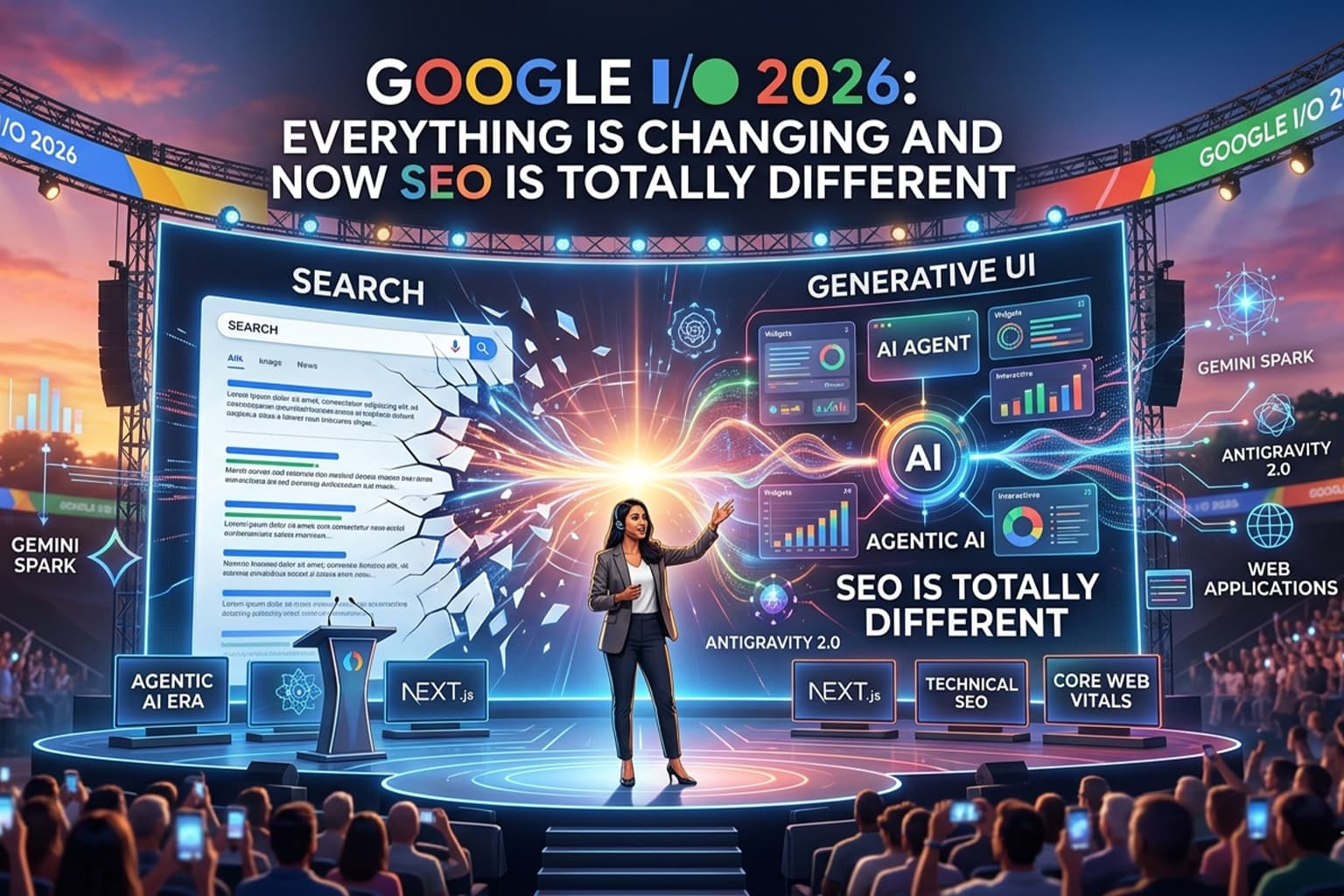
The annual Google I/O 2026 conference has dropped a massive bombshell on the digital world. If you are still relying on old-school keyword strategies, backlink spamming, or basic content writing, it is time for a massive wake-up call. Google definitively stepped beyond conversation-based interfaces into a massive architectural paradigm shift: The Agentic AI Era. The biggest takeaway from this year’s keynote is crystal clear—everything is changing, and now SEO is totally different!
As a technical writer and frontend developer, I have spent years tracking how search engines read and index code. We are no longer just building websites for human visitors; we are building them for autonomous AI agents that scan, extract, and execute tasks dynamically. To survive this shift, your development stack and optimization strategy must evolve. In this comprehensive breakdown, we will look at exactly how Google I/O 2026 is reshaping the web and how modern frameworks like Next.js and React are your only shield in this new era.
1. Generative UI: Traditional Search is Dead and Now SEO is Changed Forever
For decades, SEO was simple: you optimize a page, Google crawls it, and displays a link with a short meta text snippet. That era is officially over. With Google Search transitioning into a dynamic Generative UI experience, search engine result pages (SERPs) are no longer static. Instead, Google is using real-time generative layouts to assemble custom, completely interactive user interfaces instantly on the search page itself.
If a user searches for a complex data comparison, a live calculator, or a multi-step programming solution, Google will generate dynamic interactive widgets, real-time tracking graphs, or isolated code execution blocks right inside the search results. Because users can get their answers and interact directly on Google without clicking through to a website, traditional CTR layouts are going to drop heavily. This is exactly why we say now SEO is changing. To rank in a Generative UI environment, your website cannot just be a wall of text; it must act as a highly structured, authoritative data source that Google's AI can perfectly clip and embed into its live interfaces.
2. Why Next.js and Flawless Technical SEO Are Mandatory Now
Since Google's Gemini AI models are now generating user interfaces on the fly, your website’s technical architecture has become the single most critical ranking factor. This is where frameworks like Next.js prove their unmatched worth. You cannot rely on traditional client-side React apps anymore because delayed JavaScript execution will cause AI crawlers to skip your content.
By structuring your web applications with Next.js, you get massive, built-in advantages that align perfectly with the new AI search guidelines:
- Server-Side Rendering (SSR) & Static Site Generation (SSG): Delivers fully rendered, clean HTML to Google’s agents instantly, ensuring zero delayed content indexing.
- Flawless JSON-LD Structured Data: Because now SEO is changed, schema markup is no longer optional. Reusable schema components (Organization, LocalBusiness, FAQPage) act as the literal API blueprint for Google's Generative UI to pull data from.
- Strict Core Web Vitals Optimization: Speed is a direct ranking pillar. Next.js automatically handles image format conversion, lazy loading, and layout shift prevention to ensure perfect performance metrics.
3. Gemini Spark: 24/7 Persistent Background Agents Running the Web
The crown jewel of Google I/O 2026 is Gemini Spark. Unlike traditional chatbots where the session ends the moment you close the browser, Gemini Spark runs on dedicated virtual machines inside Google Cloud as a fully autonomous, 24/7 background engine.
Users can now assign Spark massive, long-running tasks—like managing an entire supply chain, running background documentation audits, or tracking live market trends—and it will continue executing completely offline. For web developers, this means we must shift our React frontend development mindset to support persistent, agent-driven user experiences. Web applications will need to provide endpoints, structured feeds, and accessible UI portals that these background agents can interact with smoothly.
4. Antigravity 2.0: Architecting the Future with Agent-First Development Platforms
For those of us working in core web development, the launch of Antigravity 2.0 is an absolute game-changer. It transitions code workflows into an agent-first development platform. Instead of relying on a single AI window to write code, Antigravity 2.0 coordinates an entire ecosystem of highly specialized 'subagents':
- The Architect Agent: Analyzes raw feature requirements and maps out scalable system components.
- The Engineering Agent: Writes highly optimized, modern React code coupled with clean utility-first styling rules.
- The Quality Assurance Agent: Automatically provisions isolated test suites to destroy bugs and isolate performance blocks before deployment.
- The Deployment Agent: Handles continuous integration and balances edge delivery networks.
Google also integrated a powerful migration tool inside Android Studio that seamlessly refactors legacy web and cross-platform layouts into clean, native Kotlin code. The line between different engineering environments is breaking down, making high-performance full-stack web architectures more valuable than ever.
5. Gemini 3.5 Flash & Omni: Hyper-Personalized User Experiences at Four Times the Speed
Performance and asset assembly have been taken to an extreme with the launch of Gemini 3.5 Flash and Gemini Omni. Gemini 3.5 Flash is now the core engine behind Search pipelines, executing logic and understanding code up to four times faster than older models. This means real-time AI tools inside client web apps are now instant.
Meanwhile, the Gemini Omni model acts as a multi-layered asset engine, processing text, high-fidelity audio, and cinema-grade video simultaneously. For creative frontend developers, this completely shifts our layout strategies. We can now design hyper-personalized web experiences that dynamically generate entirely custom visual assets, audio feeds, and structural components tailored precisely to a user's behavior parameters in real time.
Conclusion: Future-Proof Your Platform for the New Era
The final message from Google I/O 2026 is plain and simple: the web has evolved, everything is changing, and now SEO is totally different! You cannot win a modern digital war with an outdated, slow, unoptimized website.
Whether you need to overhaul an existing system to tap into Next.js server-side features, optimize your technical SEO data schemas so Google’s Generative UI selects your brand as a source-of-truth, or design a stunning, high-performance web application from the ground up, I can help you scale.
Get in touch today, and let’s build a fast, modern, and search-optimized web solution that dominates the Agentic AI Era.