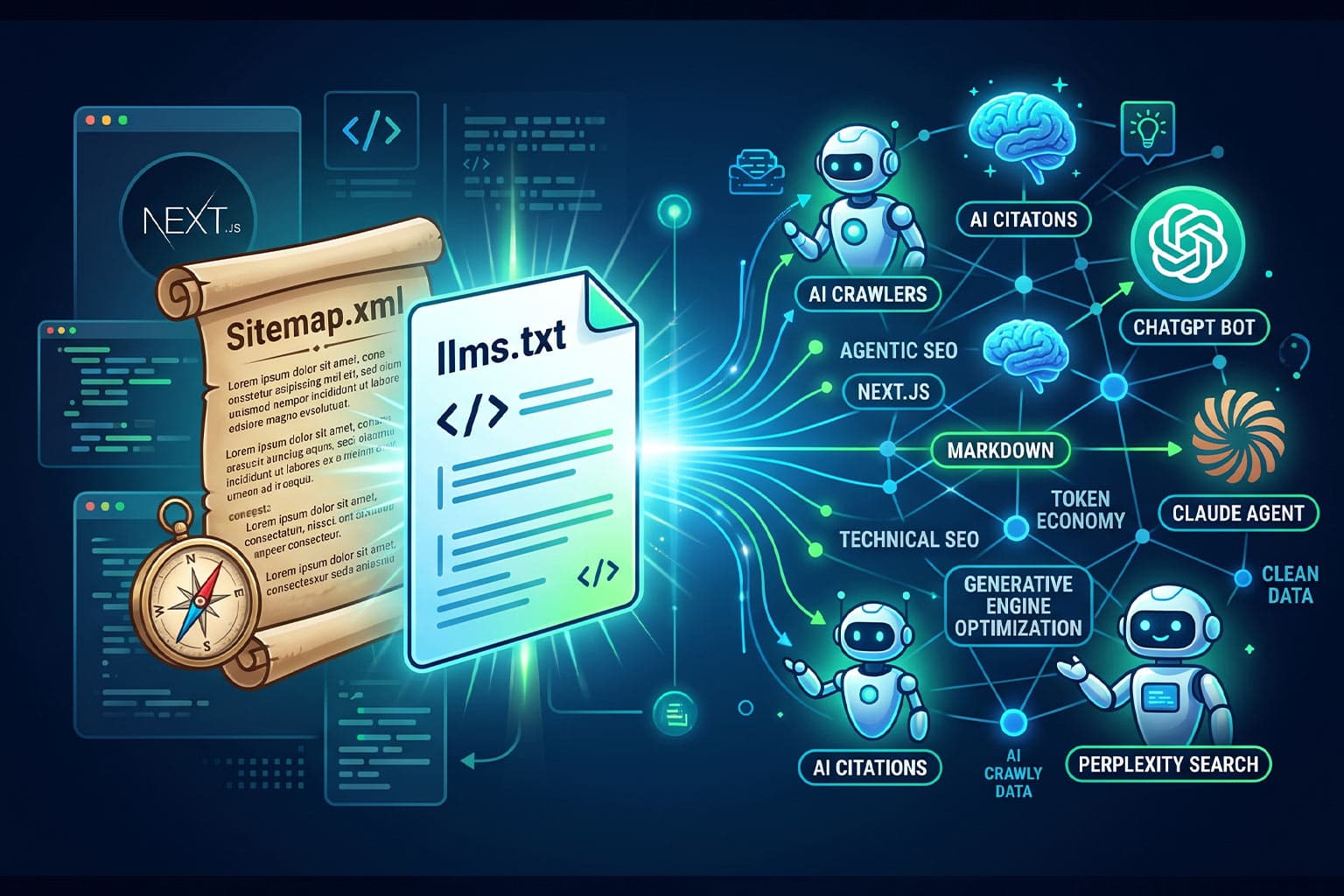
For more than twenty years, web crawlers relied on robots.txt to understand permissions and sitemap.xml to discover pages. That model worked well when search engines only indexed links. Today, autonomous AI assistants, coding bots, and AI search engines like ChatGPT, Claude, Perplexity, and Gemini actively read, summarize, and cite web pages in real-time conversations.
When an AI agent visits a modern website, it does not browse like a human. Heavy JavaScript bundles, cookie banners, ads, and complex HTML tags waste context window tokens and slow down parsing. To solve this bottleneck, developers are adopting Agentic SEO and the new llms.txt standard.
As a frontend developer and technical SEO specialist at Pixel Engine Lab, I will explain what llms.txt does, why it matters for your visibility, and how to build automated, dynamic AI routes in Next.js.
1. What Is llms.txt and Why Does AI Need It?
The llms.txt file is a proposed web standard designed specifically for Large Language Models. Placed at the root of your domain (https://yourdomain.com/llms.txt), it acts as a lightweight, clean Markdown map of your most valuable content.
- Saves Context Tokens: Instead of downloading megabytes of HTML, headers, and navigation menus, AI models receive clean Markdown text.
- Direct Content Access: You can point AI agents directly to core documentation, tutorials, and high-value articles without crawler confusion.
- Better AI Citations: By delivering structured, unambiguous facts, you reduce hallucinations and increase accurate mentions in AI answers.
2. The Core Structure of an llms.txt File
The specification follows a simple Markdown format containing a title, a short entity summary, and structured links grouped by topic:
# Pixel Engine Lab

> Pixel Engine Lab is a modern web development studio and SEO agency building fast Next.js applications and search-optimized web experiences.

## Core Documentation & Articles
- [Fix Core Web Vitals & INP](/blogs/fix-slow-website-speed-core-web-vitals-inp-guide-2026.md): Complete guide to diagnosing slow mobile web vitals.
- [Next.js Caching Pitfalls](/blogs/nextjs-caching-stale-data-guide.md): Practical steps to prevent stale CMS layouts in Next.js.
- [Generative Engine Optimization](/blogs/generative-engine-optimization-chatgpt-gemini.md): How to optimize web content for conversational search engines.

## Optional
- [About the Team](/about-us.md): Overview of our development stack, services, and engineering philosophy.
3. How to Implement Dynamic llms.txt in Next.js App Router
Rather than maintaining a static text file manually, you can generate your llms.txt dynamically using a Next.js Route Handler. This ensures that every time you publish a new blog post or doc, your AI map updates instantly.
Create a file at app/llms.txt/route.ts:
import { NextResponse } from 'next/server';

export const dynamic = 'force-static';
export const revalidate = 86400; // Cache for 24 hours

export async function GET() {
  // Fetch your dynamic blog posts or docs
  const siteName = "Pixel Engine Lab";
  const siteSummary = "Expert guides on Next.js, web performance, and technical SEO.";

  const markdownContent = `# ${siteName}

> ${siteSummary}

## High-Value Articles
- [Core Web Vitals Guide](https://pixelenginelab.com/blogs/fix-slow-website-speed-core-web-vitals-inp-guide-2026.md): Fix mobile INP and slow load speed.
- [Next.js SEO Best Practices](https://pixelenginelab.com/blogs/why-nextjs-is-best-for-seo.md): Technical checklist for top Google rankings.
`;

  return new NextResponse(markdownContent, {
    status: 200,
    headers: {
      'Content-Type': 'text/plain; charset=utf-8',
      'Cache-Control': 'public, max-age=86400, s-maxage=86400',
    },
  });
}
4. Serving Clean Markdown Endpoints for AI Bots
Advanced Agentic SEO also means delivering Markdown representations of individual blog posts when requested. By supporting clean .md routes or using HTTP content negotiation, AI crawlers can ingest your full article body in milliseconds without scraping complex DOM trees.
In Next.js, you can achieve this with a dynamic route at app/blogs/[slug].md/route.ts to serve the raw Markdown or plain text content directly.
Conclusion: Future-Proof Your Website for the AI Era
Standard search is shifting toward conversational discovery and autonomous agents. Implementing llms.txt alongside your traditional XML sitemap gives your website an edge in speed, clarity, and AI indexability.
At Pixel Engine Lab, we engineer high-performance web applications built for both human users and next-generation AI search engines.
Contact our development team today to audit your website's technical SEO and build modern, AI-ready web architectures.