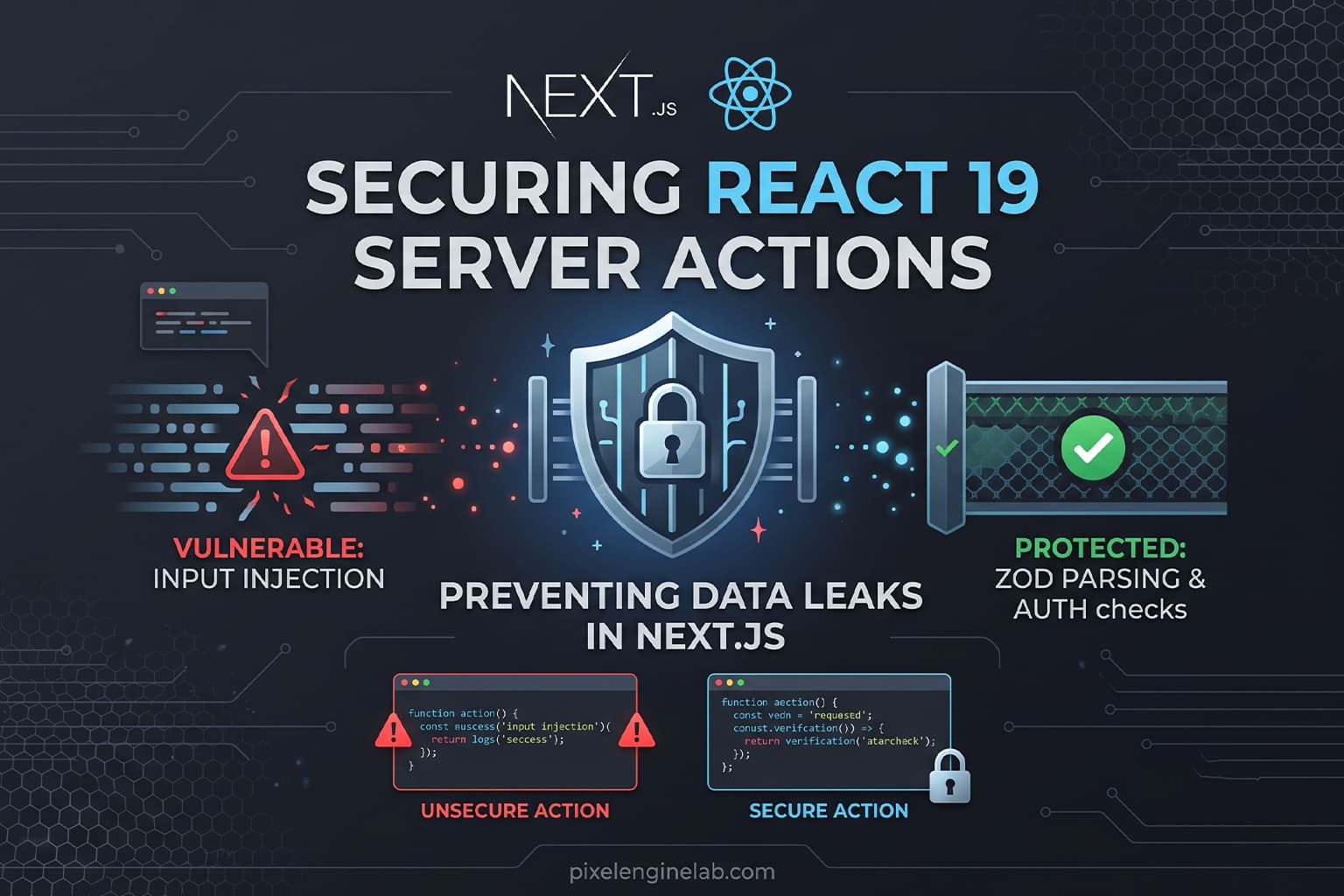
The introduction of React 19 and Next.js Server Actions completely transformed how we handle mutations and data submissions. By treating server-side code as direct, callable JavaScript functions inside our frontend layers, we effectively eliminated the need to write custom boilerplate API endpoints. But this extreme convenience introduces a massive engineering risk: developers are accidentally treating Server Actions like secure private methods, forgetting that they are exposed as public HTTP POST endpoints underneath.
As a professional web designer and developer, I am noticing an alarming trend during standard system security audits. Because Server Actions abstract away the API layer, intermediate developers frequently leave database keys, unvalidated props, and authorization checks completely wide open to parameter manipulation. If you are deploying production-ready applications, you need to know exactly how to bulletproof your server-side execution runtime. Let's look at the core code updates required to prevent data leaks.
1. The Danger of Untrusted Arguments (Input Hijacking)
When you pass an argument to a Server Action from a client-side layout form, that argument can be easily manipulated by a malicious agent using standard browser interception tools. For example, if your execution logic relies on a raw database ID passed straight from a hidden input field, a bad actor can easily swap that ID to read or overwrite another user's profile data.
To stop input hijacking, you must treat every single Server Action argument as untrusted public input. Never trust a user id or client configuration state passed blindly from the frontend container. Instead, use secure cryptographic bindings or re-verify the active session token straight from your server cookie state inside the execution routine itself:
'use server';

export async function updateProfile(userId, formData) {
  const session = await getActiveSession();
  if (!session || session.userId !== userId) {
    throw new Error('Unauthorized action detected.');
  }
  // Safe execution layer follows...
}
2. Enforcing Strict Type and Schema Validation with Zod
Because Server Actions act as open endpoints, users can pass unexpected data frameworks to cause unexpected runtime errors on your server instance. Relying on simple TypeScript definitions isn't enough because TypeScript types are completely stripped away at runtime when compiled into production JavaScript code.
You must enforce absolute validation inside the action scope using schema parsing tools like Zod. Every submission must hit a strict parse barrier before it touches your database tier. This completely neutralizes object injection vectors and malformed parameter payloads right at the edge application gateway.
3. Native CSRF and CORS Layering in Next.js
A common point of confusion is how Cross-Site Request Forgery (CSRF) affects these modern patterns. Next.js natively handles structural origin verification for standard Server Actions by default, ensuring that incoming execution calls match your host header configuration perfectly. However, if your middleware layers or deployment proxies handle origin rewrites poorly, this built-in protection can fail.
Always verify that your production network architecture enforces strict CORS rules. If your system surfaces endpoints to external autonomous agents or background indexers, isolate those routes intentionally via custom API matrices, ensuring your core internal mutations stay completely isolated behind zero-trust access parameters.
Conclusion: Security is a Non-Negotiable Core Architecture
Server Actions are an incredible feature that maximizes development velocity, but they require a rigorous, secure development mindset. Treating your asynchronous server calls as vulnerable public entry points is the only way to build reliable, enterprise-grade systems that protect client data from modern exploitation strategies.
Connect with me today, and let's run a deep technical audit to ensure your next-generation application stack is completely secure and performant.