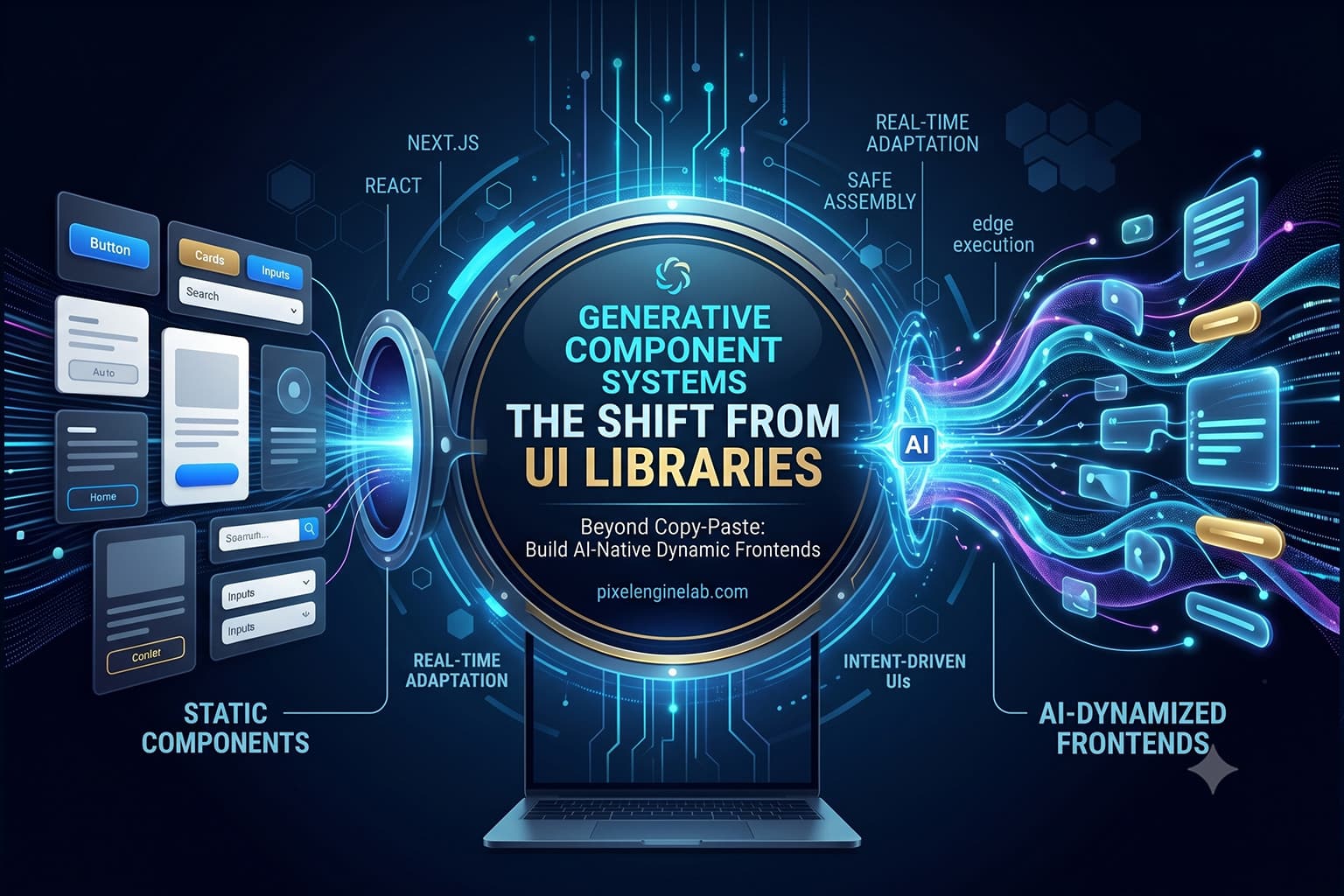
For the past few years, frontend engineering followed a highly predictable pattern. If you needed a dashboard interface, a modern modal, or a responsive form layout, you opened up a library like Shadcn UI, Tailwind UI, or Radix, copied the raw component code, pasted it into your codebase, and tweaked the theme tokens. It was a massive step up from monolithic UI frameworks, but it still left us with one massive limitation: the interfaces we shipped were completely static.
As a professional web designer and frontend developer, I am watching the architectural landscape undergo a fundamental rewrite. Entering mid-2026, the industry is rapidly transitioning away from pre-built layout blocks toward a completely new paradigm: Generative Component Systems. We are no longer just delivering hardcoded React modules; we are engineering AI-native frontends that evaluate user context and self-assemble their UI structures at runtime. Let's break down what this shift means for your development workflow and how to build these dynamic systems inside Next.js.
1. What Are Generative Component Systems?
A Generative Component System is a frontend architecture where the final layout, interactive states, and component configurations are not entirely hardcoded by the developer. Instead, the application passes real-time user data, viewport context, or plain-text intent into an inline AI orchestration layer. This layer dynamically selects, updates, or completely writes custom component code on the fly, rendering it safely inside the user interface.
Think of it as the ultimate evolution of Tailwind CSS and modular design. Instead of building ten separate variations of an analytical dashboard to fit different client preferences, you deploy a highly optimized foundation layer. The application then mutates its own data presentation layouts dynamically based on what the client asks for in real time, serving highly precise user experiences instantly.
2. Why Static UI Libraries are Hitting a Wall
Popular design libraries like Shadcn UI completely transformed developer velocity by putting code ownership back in our hands. However, they struggle to keep pace with the hyper-personalized expectations of the current web era. Here is why the static model is fragmenting:
- Bloated Conditional Trees: Catering to diverse enterprise preferences forces developers to write endless
if/elsebranches and complex prop matrices just to toggle specific layout layouts. - Zero Real-Time Flex: Traditional UI components cannot transform their visual hierarchy based on unexpected user input or newly discovered data structures without manual engineering updates.
- Heavy Client Inefficiencies: Packaging every conceivable UI state into the client bundle ruins your Core Web Vitals, causing layout performance to dip heavily.
3. The Architecture Stack: Building AI-Native Components in Next.js
Executing this shift smoothly requires a modern framework built to handle dynamic code rendering safely and fast. This is why Next.js is the perfect backbone for generative frontends. By combining Server Components with edge-side execution, we can generate custom visual states without compromising browser speed.
Here is the core architectural blueprint required to run a Generative Component System:
A. Leverage React Server Components (RSC) for Safe Assembly
Running generative code structures directly on the client side introduces massive security risks and severe layout shifts. By using Next.js Server Components, you can handle the heavy AI prompt synthesis, structural evaluation, and component parsing on the secure edge server before shipping clean, optimized HTML blocks down to the client browser.
B. Establish Strict Code Enclaves with Framer Motion
When a generative layout updates its node trees on the fly, the sudden structural changes can look incredibly jarring to a human user. To make the interface feel continuous, we use utility-first animations. Wrapping generative zones inside layoutId modules from Framer Motion ensures that when the AI adjusts a grid structure, elements smoothly morph into their new boundaries rather than snapping aggressively.
C. Implement Type-Safe Schema Validation
You cannot let an LLM write raw, unchecked code straight into your application layout without validation rules. Your system must use tools like Zod to map the AI output against strict, pre-approved structural tokens. The AI defines the data relationships and component priority, while your underlying React system guarantees that the visual presentation adheres to your core branding and design primitives.
4. The Commercial Edge: Why Intent-Driven UIs Win More Clients
Moving your platform toward an agent-ready, generative design framework isn't just a technical achievement; it is an incredible business accelerator. For companies looking to convert traffic into active leads, intent-driven layouts are completely changing the conversion funnel.
Imagine a web solution where a user lands on your portal, and instead of clicking through complex navigational tabs, they simply type a request. The system instantly modifies its interactive presentation decks, forms, and technical feature tables specifically to address that single user's industry parameters. That level of responsiveness completely obliterates bounce rates and establishes unmatched brand authority.
Conclusion: Evolve Beyond the Copy-Paste Era
The frontend development rules are shifting faster than ever. Relying purely on basic, static component libraries will eventually make a digital experience feel rigid and outdated. Transitioning into Generative Component Systems ensures your products remain flexible, incredibly personalized, and highly performant.
At Pixel Engine Lab, we focus on engineering rapid, Next.js application platforms equipped with modern, AI-integrated UI architectures built for maximum technical performance. Let’s modernize your development stack and transition your platform into the modern digital era.
Connect with me today, and let’s architect a cutting-edge web application that outpaces your competition.