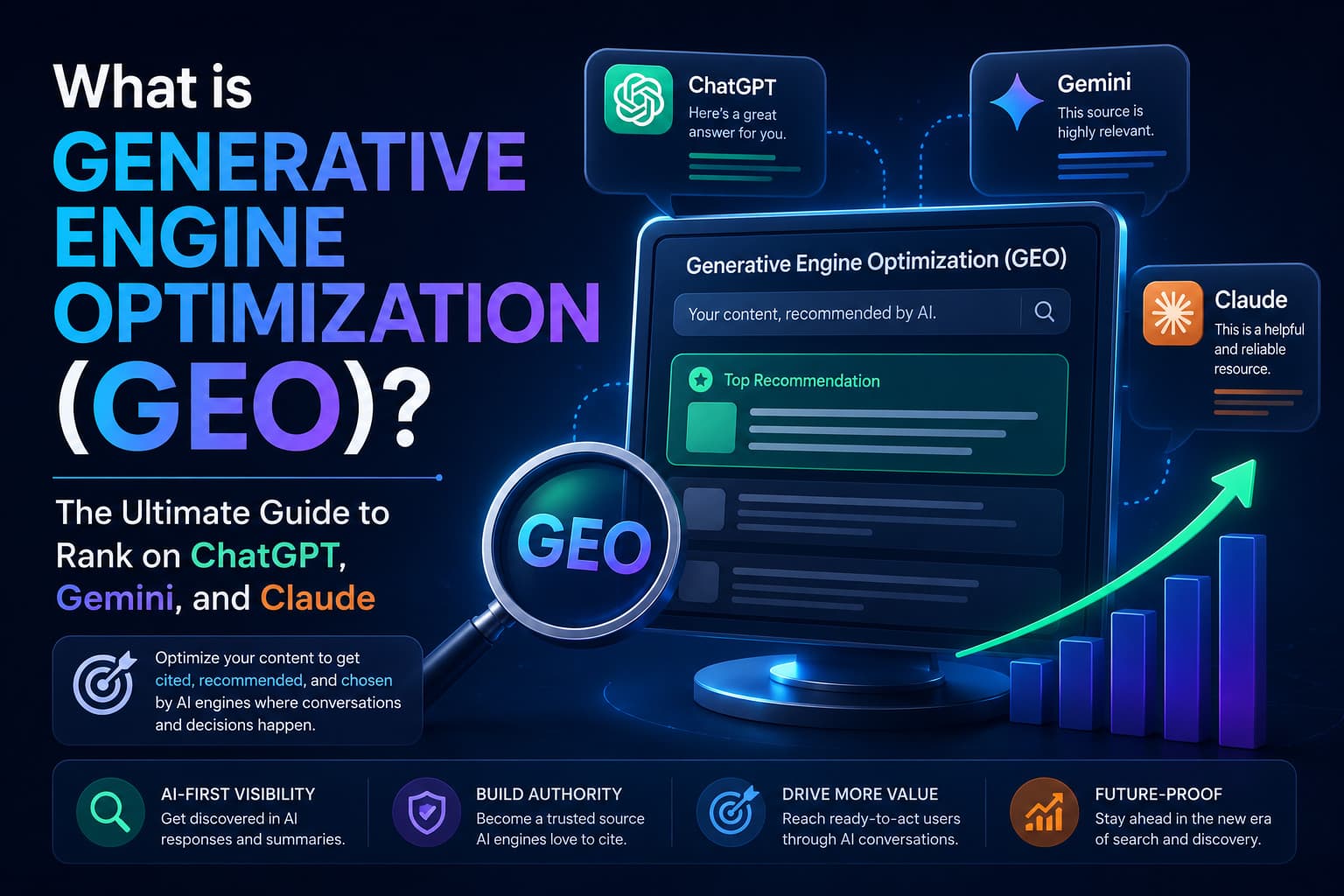
If your website analytics are showing a sudden drop in organic traffic lately, there is a very specific reason behind it. The core behavior of internet users has fundamentally shifted over the last few months. Instead of scrolling through pages of blue links on Google, a massive portion of your audience is now asking direct, complex questions to platforms like ChatGPT, Google Gemini, and Claude. If your platform isn’t showing up inside these conversational summaries, you are missing out on incredible visibility.
As a technical writer and frontend developer, my focus is always on how modern code structures interact with modern web indexers. Following up on my breakdown of Google I/O 2026 and how it affects creators, we need to focus on a concrete execution layer. To keep your traffic alive and growing, you need a strategy tailored for this ecosystem: Generative Engine Optimization (GEO). Let's break down exactly how it works and how to practicalize your frontend code to capture it.
1. What is Generative Engine Optimization (GEO)?
Generative Engine Optimization (GEO) is the technical workflow of structuring your web assets so that LLM-driven search engines and conversational engines cite your data as their primary source of truth. Traditional SEO heavily rewards raw keyword matching, domain age, and absolute backlink volume. In contrast, GEO prioritizes clean information depth, authoritative structural clarity, and instant accessibility.
When an engine like Gemini or ChatGPT processes a user query, it parses available web resources in real time to assemble an answer. It targets platforms that offer straight-to-the-point answers built on solid code architectures. When your application hits these metrics, the engine displays your platform as an inline citation, links directly to your source, or embeds your UI components inside the answer layout. This is where your highest-converting traffic now originates.
2. Why Traditional Websites Fail and How Next.js Saves Your Traffic
AI bots operate fast, and they have strict resource limits when scraping. If your website depends on a legacy architecture or a heavy, purely client-side rendered React setup, these scrapers will drop your page before it even finishes running its primary scripts. They simply cannot afford to wait for heavy client-side JavaScript execution, which is why Next.js has become non-negotiable for modern SEO and GEO setups.
When we build using Next.js, we eliminate these parsing bottlenecks for AI scrapers immediately:
- Server-Side Rendering (SSR): AI crawlers get a clean, fully compiled HTML document on the first byte. The system indexes your complete data layout instantly without waiting for background client scripts to fire up.
- Sub-Second Performance: Lightweight asset delivery keeps your site compliant with aggressive scraping timelines. Next.js optimizes images, scripts, and fonts right out of the box to maximize crawl efficiency.
3. The Actionable GEO Blueprint: How to Rank Inside AI Answers
Getting your web pages pulled as a premium citation by ChatGPT or Gemini requires a combined focus on clear text delivery and strong developer habits. Here is the operational blueprint we run across our production setups at Pixel Engine Lab:
A. Speak the Language of Schema (JSON-LD)
Large language models look for programmatic consensus, which means structured data is the absolute bridge between your database and an AI answer. Schema files are effectively public API endpoints for search crawlers. It is critical to write comprehensive JSON-LD files covering your Product sheets, LocalBusiness details, Organization parameters, and FAQPage arrays.
For instance, building a modular, reusable React wrapper to handle schema injection gives Google's dynamic search elements an explicit data structure to pull from, creating native widget embeds directly on the user's dashboard.
B. Structure Content with "Chunk-Friendly" Formatting
LLM search logic splits content blocks into semantic tokens to process ideas. If your technical guides or insights are trapped inside massive, unformatted blocks of text, a parser will simply scan past them. We have to make our data layout scannable for machines:
- Write direct, question-focused H2 and H3 tags (e.g., "How do you optimize for GEO?").
- Provide a concrete, high-density answer within the first two sentences immediately under that title.
- Leverage semantic bullet points, ordered lists, and data tables to give the bot explicit reference points.
C. Optimize for Conversational, Long-Tail Queries
People use continuous human sentences when interacting with an AI interface. No one opens a chat window and types "best web designer Delhi" anymore. They ask, "I want an experienced MERN stack developer in Delhi to build an animated portfolio using Next.js and Tailwind. Who has verified live projects?". Tailoring your copy around these long-tail, high-intent phrases brings in readers who are looking for direct answers.
4. Building an Agent-Friendly Web Architecture
With tools like Google’s Gemini Spark running background operations and managing offline tasks for users, web engineering demands a major rethink. We are rapidly transitioning into a digital space where web layouts aren't just viewed by people—they are audited, cross-referenced, and sorted by automated software agents working for users.
As engineers, our target is to ensure our React design systems, form fields, and navigation trees are completely parsable. Relying on strict semantic HTML markup (such as <main>, <article>, and <nav>) acts as a clean layout roadmap. This allows background automation to map your business offerings smoothly, which directly boosts your platform's recommendation rate.
Conclusion: Future-Proof Your Architecture Before Your Competitors Catch On
The operational rules of search ranking have changed permanently. Sticking with legacy frameworks and outdated 2022 optimization workflows will inevitably cause a platform's organic reach to flatline. Implementing a clear GEO framework is the absolute best way to keep your platform visible, attract intent-driven leads, and protect your digital footprint.
At Pixel Engine Lab, we focus on engineering rapid, Next.js code setups integrated with deep technical SEO frameworks built to capture AI search traffic. Let's modernize your application layout and secure your business platform ahead of the curve.
Connect with me today to suggest topics or discuss frontend technologies.